Vicky’s sister Irene left Hong Kong last Saturday, after collecting the remainder of Vicky’s effects from the North Lantau Police station on Friday afternoon. Accompanying her were members of the Justice for Vicky concern group and Mr Gil Salceda, Head of the Assistance to Nationals Section at the Philippine Consulate. Mr Salceda also attended every session of the inquest, and deserves special recognition for his care and concern since April.
We would like to thank everyone who has left messages on this blog, and all of you who showed your support in other ways. The voyage has been long and we didn’t expect the destination at which we arrived, but everything we did was worthwhile.
Soon we will decide whether to continue with this blog under a new name and document the many elisions of justice that domestic helpers face in Hong Kong, transfer all of the material to a new blog, or transfer it to the administrator’s personal blog, which also documents the travails of migrant workers, amongst other things.
In the meantime, thank you for reading what we have offered. Spare a thought for Vicky when you can, and for all people who have no-one to turn to in times of need.
Now that the jury has given its finding, we would like to offer a few comments about the inquest. Most important, the Coroner acted impeccably throughout, directing the proceedings with equanimity and offering the jury very specific directions about how it should go about its decision.
Particular attention was given to weighing the evidence and determining whether the witnesses were credible. Despite what the South China Morning Post has been reporting, most of the evidence given was very run of the mill, going to establish Vicky’s character in a positive light. Two specifically negative assessments came from Vicky’s supposed ‘best friend’ in Hong Kong and ‘boyfriend’ in the Philippines (in the later case through the interpreter who spoke to him over the phone).
These assessments seem to have persuaded the jury to make a leap of logic from a woman in Discovery Bay who was suffering from headaches, was clearly overworked and perhaps having some associated, and no doubt stress-related, mental difficulties to a suicide on the other side of Lantau island.
The jury, it must be said, had a difficult task in determining Vicky’s actions when they had next to no material evidence to consider. The inquest was essentially a rehash of the various statements made to the police from April to around June. However, the level of English comprehension expected of them was much higher than the norm in Hong Kong (blog administrator Mike Poole is a managing editor and writer for Chinese speaking people who use English as a second language, so this a professional assessment). There were also numerous references to Filipino cultural phenomena left unexplained, such as the penchant for labeling denominations separate religions and an entire corpus of folklore from southern Luzon remarked upon as though its implications were obvious.
This was compounded by the lawyer for Vicky’s employers, who encouraged the jury to take the view that Vicky’s seemingly unstable mental state should be their major consideration, despite evidence from his own clients that they had noticed nothing unusual about the woman in the days leading up to her death. Essentially, the lawyer acted as a prosecution counsel, as though Vicky’s character were on trial.
Given these aspects of the inquest, and the fact that Vicky’s sister Irene had no legal representation to counter their effects, the finding of suicide – rather than the proffered alternative of an open finding – is not entirely surprising. It is, however, disturbing because the overwhelming majority of the evidence presented was inconclusive, and suicide should be a finding backed by probative facts.
The one jury member who voted against the finding should be congratulated for elevating logic over supposition. Nevertheless, the process has run to its conclusion. In that sense we have ensured that natural justice, which is otherwise know as procedural justice, has been served. There is no appeal mechanism to push the case further, so we have to be satisfied with the fact that we pushed it thus far, when all indications were nothing would be made of it at all.
Tomorrow, most members of the Justice for Vicky concern group will meet again to discuss what we have learned, how we fared and what we can do in future. Tonight we will think of Vicky’s death as an ever unsolved mystery.
The jury has given its finding at Vicky’s inquest. After accepting directions from the Coroner to weigh the evidence, in a 4-1 majority decision they found that Vicky committed suicide.
The South China Morning Post has again reported incorrectly on Vicky’s inquest. Despite the headline on page 3 of the City section today, Vicky did not ‘visit’ a ‘witch doctor’ (otherwise known as a ‘quack’) about her headaches. A friend, supposedly a ‘boyfriend’, did on her behalf, taking a picture of Vicky with him.
So much for attention to detail from the SCMP‘s subeditors.
The witness mentioned in the article who made the claim that Vicky was “out of her mind” shifted uneasily in her seat when Irene, Vicky’s sister, questioned her about this, kept looking down and moved her gaze from side to side. She also raised her voice defensively when questioned about how she knew that Vicky did not have good relations with her family. Her claim was that Vicky told her so.
In other words, she was presenting hearsay evidence.
A final point about the article is that it relies on the insinuation that Vicky was in debt at the time of her death. The 4 loans she was reported to have taken out were all repaid in full and on time. One of the final witness to speak was the proprietor of the business from which she took the loans, who mentioned this. The SCMP conveniently failed to follow suit.
The article’s author, Chandra Wong, should be ashamed of herself. She should also be forced to admit she didn’t even bother to attend the morning session of the inquest, when she was presumably sitting in on another trial in the same building (the report on that trial appeared beside the report on Vicky’s inquest). If she had, she would have heard the bulk of the detail of the supposed ‘visit’ to the ‘witch doctor’ read out by Judiciary interpretor who spoke to Vicky’s supposed ‘boyfriend’ in the Philippines, and less salacious testimony presented in person by other witnesses.
Throughout this case, the SCMP has been chasing a story quite at odds with the available evidence. It will be very interested to see what it makes of the finding tomorrow. We will report that finding here as soon as it becomes available today.
The third day of Vicky’s inquest heard testimony from 4 witnesses, including the proprietor of the company from which she borrowed and paid back money, the judiciary interpreter who spoke to persons of interest in the Philippines, and the police investigators.
The witness whose testimony carried over from yesterday repeated an assertion that she had made in her statement to the police – that she thought Vicky was loosing her mind. When questioned by Vicky’s sister Irene about this she became defensive and stressed that it was her interpretation of the situation only.
The judiciary interpreter read the statement of Vicky’s supposed ‘boyfriend’ in the Philippines, who claimed that the woman had tried to have constant headaches cured by a ‘quack doctor’, who insisted that Vicky’s former boyfriend was trying to ‘bewitch’ her and that she was, somehow, ‘queen of the dwarves’, amongst other things.
Although such assertions would be dismissed as hearsay in other courts, they could point towards Vicky’s state of mind at the time of her death in the Coroner’s Court. The employer’s lawyer stressed their importance in his final comments to the jury. What the jury actually makes of them will be resolved tomorrow morning, when a finding is scheduled to be handed down.
We will report the finding as soon as it is handed down
The second day of the inquest into Vicky’s death saw evidence given by another 8 witnesses. The doctor who performed the autopsy explained the state of the body and confirmed once more that Vicky died by drowning.
The final witness for the day ranged over wider ground, speaking of Vicky’s previous ‘boyfriends’, that the woman had been suffering recurrent headaches at some stage – but not immediately before – she died, Vicky’s use of ‘holy oil’ and matters relating to whether or not long-service leave would be taken.
This evidence has already been given to the police during their investigation, and the long-service issue has been dealt with through the Labour Department mediation process. Nevertheless, it will be interesting to see what the South China Morning Post makes of it tomorrow.
The final witness will speak again tomorrow, and two more witnesses will be called.
NOTE FROM THE BLOG ADMINISTRATOR: As the Thorough Investigation page on this blog might contain speculation capable of influencing those directly involved in the inquest hearings, I’ve removed it until the jury hands down its finding about Vicky.
The inquest into Vicky’s death began yesterday, with the composition of a 5 member (3 woman, 2 man) jury and the calling of 11 witnesses. Vicky’s sister Irene was given the chance to question her sister’s former employers, who were in court and represented by a lawyer.
No new evidence was given, as can be expected, and reports in the South China Morning Post of Vicky receiving a ‘love’ letter the day before she disappeared are reiterations of information obtained by the police during their investigation.
The inquest continues today, with more witnesses being called. Given that there are a total of 27 witnesses, the hearing could finish ahead of the projected one-week time frame, but other matters could yet prolong the proceedings.
We will report later today on any matters of interest arising from the current session.
Addendum – further to an earlier comment, the text message mentioned in today’s issue of the South China Morning Post was one of those that it earlier claimed to have included ‘cult-like references’. The North Lantau police have already investigated the matter.
Preparations are now underway for the inquest into Vicky’s death. The police have contacted witnesses and we are very pleased to announce that Vicky’s sister Irene can now be in Hong Kong for the week.
The inquest will begin next Monday, the 17th of Novemeber – you can check one of the earlier posts for the time and location details. We will post any further information that comes to hand before the process starts.
Vicky’s sister Irene informed us last night that she will be unable to attend the inquest scheduled to start on 17 November. Very unfortunately, her husband has been involved in a motorcycle accident in the Philippines. Aside from any other considerations, Irene would now have no-one to look after her two young children if she came to Hong Kong for a week.
Our thoughts go out to Irene and her husband, whom we wish a speedy recovery.
Vicky’s sister Irene has informed us that she will return to Hong Kong for the inquest. Another sister may also be present, but we have yet to confirm that. As usual, we will provide more information as soon as we have it.
You can click on the address link above for a map. Sai Wan Ho is on Hong Kong island and can be reached on the MTR Island Line heading towards Chai Wan.
The inquest will be held in an open court and is expected to run for a week. We hope to see as many people there as possible.
We have just been informed that an inquest into Vicky’s death will be held in mid-November. Word reached us this afternoon from Edith, Vicky’s aunt, who was informed by the Philippine Consulate.
Full details, including dates and other information, will be passed on to us this evening or tomorrow. We will report them as soon as we can.
Since forming the concern group we have become more aware of the many concerns that domestic helpers have about their work conditions and personal safety. Each week we help someone in some way, providing temporary shelter for abused women, helping some to deal with threatening employers, directing others to support organisations and raising money when we can.
Today we want to tell you about a friend of ours, someone we helped out a few months ago. Beth’s story is similar to those of increasingly more domestic helpers in Hong Kong. It might not be the most dramatic tale but it does indicate the contempt with which helpers can be treated, and what they can do to gain recompense.
Read on . . .
When Beth arrived in Hong Kong the situation seemed promising. Her employer lived with his fiancé in Discovery Bay, a tidy, quiet and often friendly district on Lantau island. But on the first night she had to sleep on the couch because the separate room mentioned in her domestic helper contract was a lie. And when her employer left for Singapore two days later her life descended into misery.
With the employer out of sight, his fiancé proceeded to assault Beth. The slightest mistake in any aspect of housework brought swift retribution, first in foul language and then in beatings on the arm. One day she was hit in the face with a book. Desperately worried about her own safety and how she would support her three-year-old daughter in the Philippines if she fled, Beth fell into confusion, made worse by constant hunger because she was only allowed one meal a day.
Less than a week after arriving, this shy, unassuming woman had a knife thrust at her face, and six days later she was dismissed. She sought help from the Mission for Migrant Workers and found accommodation with friends of the Bethune House Migrant Women’s Refuge. But she still had a struggle ahead.
The Lantau police dismissed Beth’s claim of assault in a form letter, citing insufficient evidence. Her employment agency resisted cancelling a loan it forced her to take in the Philippines to cover illegal placement fees, but eventually relented. Beth’s former employer ignored the case she presented to the Labour Department for unpaid wages, only appearing when it went to the Minor Employment Contract Adjudication Board. During the hearing he berated Beth for ‘running away’ and pressed her to apologise. He finally paid only part of the claim.
Beth recently filed an application for a change of employment status with the Immigration Department. In two weeks she will take up a contract with new employers – a fundamentally decent family. She has friends in Discovery Bay now, and elsewhere in Hong Kong. But more importantly she has hope.
An earlier, slightly different version of Beth’s story appeared in Migrant Focus, the monthly newsletter of the Mission for Migrant Workers here in Hong Kong. We will include links to Migrant Focus in the sidebar soon, so that readers can learn more about what the Mission and Bethune House are doing for domestic helpers in distress.
Given the current lack of news on whether an inquest will be held into Vicky’s death, we will dedicate the next few posts to details of other cases we have been involved in, both within Discovery Bay and in other parts of Hong Kong.
The saddest fact that we have encountered since coming together after Vicky’s disappearance is that abuse is happening to domestic helpers at many levels, more so than even the more cynical amongst us might think. Aside from the many people we have referred to Helpers for Domestic Helpers, mainly for contract violations by employers, we have been working with the Bethune House Migrant Women’s Shelter and its parent organisation the Mission for Migrant Workers in aiding physically distressed helpers.
We will, of course, offer any news available on Vicky’s case, but the next post will feature Beth’s story, written by one of the concern group and published in the Mission for Migrant Workers newsletter this month.
A representative of the Philippine Consulate wrote to the Coroner’s Court recently, asking whether a decision has been made about an inquest into Vicky’s death. Since then, numerous follow up calls have not yielded any information.
As we know from our experience in helping other people who are facing the court system in Hong Kong, the process can be excruciatingly slow. A serious assualt case can take six months or more to reach the District Court. This is often due to the sheer number of cases pending, and we don’t rule out that possibility in relation to the Coroner’s Court.
However, it does does seem typical of Vicky’s case that respsonses from the authorities are very slow in coming and somewhat unhelpful when they arrive.
We will relay any further information as soon as it becomes available.
A representative of the Philippine Consulate here in Hong Kong has finally contacted the Coroner’s Office, inquiring about whether an inquest will be held into Vicky’s disappearance and death. The Coroner is apparently still considering the case.
We will continue to monitor the situation and will provide updates when they come to hand.
Vicky’s sister Irene and aunt Edith have both been attempting to contact the head of the Assistance to Nationals Section of the Philippine Consulate here in Hong Kong. Edith, in particular, has rung a number of times, but she has yet to receive a return call. Both women are attempting to find out whether the Consulate has contacted the Coroner’s Office and has any news about whether Vicky’s case will be subject to an inquest.
The most obvious answer to that question at the moment would be that no contact has been made.
It is very probable that the Coroner is close to reaching a decision on the case, or has already made a decision, but without Consular efforts Vicky’s family is unlikely to hear any news until it is made public.
We will continue to monitor the situation and will report any information here as it comes to hand.
When recently approached by a member of the Justice for Vicky Flores concern group, the Assistance to Nationals Section of the Philippine Consulate here in Hong Kong was unaware that the police had finalised their investigation into Vicky’s disappearance and death. Section head Mr Gill Salceda indicated that he would attempt to contact Vicky’s family with the news, including the Coroner’s consideration of an inquest.
A representative of the Consulate could well be considered a Properly Interested Person under Schedule 2, Part 9 of the Coroners Ordinance, which would allow them to know when a decision is made about an inquest before the scheduling is announced publicly. Any contact with Vicky’s family now would certain help when requesting to be granted that status.
We urge the Consulate and Mr Salceda to follow through and make official contact once more.
Bethune House in Jordan on Hong Kong’s Kowloon side provides temporary accommodation for domestic helpers who have been wronged by their employers and are seeking justice through the Labour Tribunal, the courts or both. The organisation urgently needs help with food and monetary donations.
The House has 22 bed spaces but is currently sheltering just over 60 residents who have been exploited and abused. It only has enough rice to feed these women for around a week. Anything you can give will be very much appreciated.
Details are as follows.
—————————————————————-
BETHUNE HOUSE FOOD DRIVE
SUPPORT FOR DOMESTIC HELPERS IN DISTRESS
The Bethune House Migrant Women’s Refuge provides temporary shelter for domestic helpers with
ON-GOING LABOUR CASES
We urgently need donations of foodstuffs such as rice, coffee, cooking oil, sugar and milk to feed our residents
Tax deductible CASH donations will also be accepted. Cheques should be payable to:
“The Bethune House Migrant Women’s Refuge, LTD.”
Address: c/o Mission for Migrant Workers
St. John’s Cathedral, 4-8 Garden Road, Central
Tel: (+852) 2537-1333 or (+852) 9488-9044
—————————————————————-
The Bethune House Migrant Women’s Refuge Limited is a registered charitable institution under the Companies Ordinance (Cap 32) of Hong Kong
Recent bad weather in the Philippines has barred Sister Aida Casambre from travelling to Batangas and speaking to Vicky’s elderly mother about what has been happening with the investigation into her daughter’s disappearance and death here in Hong Kong. Fortunately, though, Vicky’s aunt Edith was in the country last week and spoke about the situation.
Edith reports that Vicky’s mother was unaware of the continuing investigation, and had presumed that the case was closed without any detailed explanation offered for her daughter’s death. Hopefully an inquest will help to remedy that situation.
We still have no news about whether the Coroner will order an inquest into Vicky’s death. As that decision will necessarily be made without public consultation, we will only know of the outcome after the fact or if any information is leaked to the newspapers.
In the meantime, and presuming that the police have not identified a crime in their report, the following information from the Judiciary’s website indicates that an inquest “may” be held when a person dies:
suddenly
by accident
by violence
under suspicious circumstances
and when the dead body of a person is found in or brought into Hong Kong
The Coroner’s Ordinance of 1997 (Chapter 504 of the Laws of Hong Kong) indicates that the first 4 categories are conditional. In other words, the death can happen suddenly, or by accident, or by violence or under suspicious circumstances, as long as the body is found in or brought to Hong Kong.
At least 1 of the first 4 conditions (suspicious circumstances) is met in Vicky’s case.
As mentioned briefly in the South China Morning Post today, 14 August, the North Lantau police have finalised their investigation into Vicky’s disappearance and death. Their findings have not yet been made public.
In line with standard police procedure, the report has been forwarded to the Coroner, who will consider whether an inquest is necessary.
Given the publicity surrounding both Vicky’s death and the investigation into it, an inquest seems likely, but is in no way guaranteed. Further news will be reported here as soon as it becomes available.
For anyone with enough time to read through it, Migration and Domestic Helpers is a blog well worth visiting. Maintained by a woman who spends time in both the Philippines and Hong Kong, the blog covers the many problems faced by migrant workers in the region.
The blog’s author, Helly, writes that:
I work with domestic workers in need of help due to underpayment of wages, premature termination of the employment contract, passport confiscation, or excessive placement or training fees in the home country. The majority of the women I encounter are Filipino and Indonesian. This blog is my attempt to understand the reasons why migrant workers are vulnerable to abuse and exploitation.
Particularly interesting are Helly’s observations about a severance pay dispute involving “Remia”, a Filipino domestic helper here in Hong Kong. This sort of thing is happening in Discovery Bay with increasing frequency.
“RosesmdCW”, a Filipino domestic helper in Clearwater Bay, has been following Vicky’s case since we began posting news about it here. She left a long comment on the Thorough Investigation? page last week that deserves to be shown here in full because it gives yet another example of how Hong Kong is failing in its duty of care towards migrant workers.
The comment has been edited slightly to ensure clarity, and broken into paragraphs to emphasise the main points. Further comments on this or any other case are very welcome.
I have been reading about “VICKY” and what’s happening with her case now; it really makes me sad to think that up to now nothing has happened.
I have been here in Hong Kong for almost 14 years now, and it makes me sad to say that most of us believe that the “LAW” here in Hong Kong is much better than in the Philippines, but yes I do agree that the discrimination here is much worse than I have ever imagined. If you are only a mere servant, even in cases of emergency, people here will just ignore you.
I have experienced going to the emergency section of the government hospital several times with a severe stiff neck pain, and still the staff haven’t attended to me immediately (you have to wait 2 to 3 hours before being attended).
I took my sister to one of the hospitals yesterday as she was bleeding, but she was still sent home and advised by the doctor to wait for an appointment on November 21, 2008. My question here is: What does “emergency” mean? Does emergency mean that you should be drawing your last breath to be considered?
I really can’t understand the hospital rules here … I saw people waiting at the emergency section with just slight problems. To make matters worse for my sister, she was immediately terminated by her employer when they knew she was to attend Emergency! They had objected to her going to see the doctor and made her continue work even though she was in pain and bleeding.
I wish the government would really act on this, and not wait until the reputation of Hong Kong deteriorates further.
If you know anyone in a situation like this, please ask them to contact Helpers for Domestic Helpers, or another group that can help with arranging action through the Labour Tribunal. What “RosesmdCW” describes is not a termination but a contract breach by the employer.
The Philippine Consulate has again contacted the Tung Chung police to ask about progress in Vicky’s case. Mr Gil Salseda of the Assistance to Nationals Section passed on the news when contacted by a member of the Justice for Vicky concern group late last week. As soon as we have word of an official reply we will report it here.
Sister Aida Casambre, member of the Justice for Vicky concern group and tireless worker for social justice with the Diocesan Pastoral Centre for Filipinos, will visit Vicky’s mother when she returns to the Philippines for a 6-month sabbatical next week.
Sr. Aida will explain the efforts of various groups seeking justice on Vicky’s behalf, the current state of the police investigation and any other matters of interest.
We wish Sr. Aida all the best and look forward to seeing her again when she returns to Hong Kong next year.
In a letter responding to our request last month for more information about the early police investigation into Vicky’s disappearance and death, the Lantau District Commander has informed us that “a death inquest is very likely to be held”.
This, of course, is not the first time that the possibility of an inquest has been raised, but it is the first time that the District Commander has expressed the likelihood in writing.
The statement corroborates independent advice about the likelihood of an inquest that the Justice for Vicky concern group received recently.
The Know Your Rights seminar for domestic helpers held in Discovery Bay today, 27 June, was very successful. Attracting 70 participants, the event covered rights in relation to employment, the police and the Immigration Department.
The participants were eager to ask questions, and presenter Holly Allan, Manger of Helpers for Domestic Helpers, offered very practical advice at all times.
The event concluded with a short talk by Sol Pilas, a representative of UNIFIL Hong Kong and member of the Justice for Vicky concern group, updating participants about the ongoing campaign to return domestic helper wages to the 2003 level and abolish the levy paid by employers.
It is very encouraging to see the recent comments on the importance of knowing your rights, even though not having to defend them would be a much more hopeful scenario. Still, the reality of being a domestic helper in Hong Kong is not always promising.
For those of you who have the time, an easy to read academic study of how Filipino domestic helpers in particular are treated in Hong Kong Hong, including social attitudes towards them and how the justice system treats them, has recently been made available free online.
Estelle Kennelly’s ‘Culture of Indifference: Dilemmas of the Filipina Domestic Helpers in Hong Kong’ covers the situation until 2007, but mainly focuses on the period from mid-1999 to early 2001. Kennelly worked with and around migrant women’s shelters, including those associated with the Mission for Migrant Workers.
Her major finding, which is obvious to many but should be stated openly, is that a culture of indifference towards foreign domestic helpers in Hong Kong fosters abuse. The study, a PhD thesis, is a very important document.
The Know Your Rights seminar will be held on 27 July in Discovery Bay. The details are as follows:
Date: Sunday 27 July
Venue: Multi-Purpose Hall at the back of Park ‘N Shop
Time: 2.00 PM to 5.00 PM
Presenter: Mrs Holly Allan, Manager of Helpers for Domestic Helpers
As mentioned previously, Holly is very experienced in explaining legal rights for domestic helpers, and approached us to help her organise the event. She will be more than happy to answer all the questions she can during her talk.
The seminar is open to domestic helpers and their supporters of all nationalities.
A note to all readers. Any comments that contain personal abuse will be deleted. That includes all comments from “chedycorum”, who should find something better to do with her life.
Irene has now managed to deposit the payout for Vicky’s salary and long service entitlements with Metrobank in the Philippines. In doing so she was aided by the Philippine Consulate in Hong Kong and the Department of Foreign Affairs in the Philippines.
The money will not be available to Vicky’s elderly mother for another month, but the situation has certainly improved since our last report.
Vicky’s sister Irene has been facing great difficulty in trying to deposit the Cashier’s Order she received on behalf of her mother in payment for her sister’s outstanding salary and long service entitlements.
As Vicky was solely responsible for supporting her elderly mother, this situation is very worrisome.
The Cashier’s Order was drawn on the Shanghai Commercial Bank, a small Hong Kong bank (despite the name) that does not seem to have branches in the Philippines. This means that even with power of attorney for her mother, Irene can’t open a bank account into which the Order can be deposited.
Irene, who has been working tirelessly to see this matter resolved, faced similar problems while here in Hong Kong, and was advised by the issuer that she could deposit the Order in the Philippines.
The situation will be addressed fully tomorrow, with enquiries directed at the Philippine Consulate and through it the lawyer of Vicky’s former employers. Further news will be posted here once it becomes available.
As previewed earlier on this blog, a seminar on legal rights for domestic helpers will be held on Sunday 27 July in the management seminar room, Discovery Bay Plaza. The seminar will open to all domestic helpers and their supporters, regardless of nationality.
Holly Allan, Discovery Bay resident and manager of Helpers for Domestic Helpers, will conduct the seminar. She is very good at covering issues of concern to all domestic helpers, and is always willing to answer questions.
The event should last from 2 to 3 hours, and we will announce the exact time and location early next week.
Unfortunately, the Tung Chung police were not forthcoming with any news on Vicky’s case when her sister Irene visited their headquarters yesterday. Irene had been hoping to learn when the investigation would be concluded, but she was told it would now run for another month.
This new estimate exceeds the last and suggests that the police could well be unsure how long their current tasks will take.
Irene did, however, retrieve six of at least 15 of her sister’s belongings that the police were holding. Notably the police retained Vicky’s two mobile phones – one used for local calls and the other with a roaming sim card used for texting the Philippines.
Vicky’s sister Irene will visit the Tung Chung police headquarters tomorrow, July 3, accompanied by a representative of the Philippine Consulate.
She will be asking for any further news on the police investigation into Vicky’s disappearance and death before returning to the Philippines on Friday morning.
Any information that Irene passes on will be announced here as soon as it is available.
Hong Kong News, the largest circulation Filipino newspaper in the city, has maintained its coverage of Vicky’s case in its main July edition. Two articles feature on the second page, one reporting an interview with Philippine Vice-Consul Val Roque and the other with Justice for Vicky spokesman James Rice.
The interview with the Vice-Consul covers the payment of outstanding salary and long-service entitlements by Vicky’s former employers, with no news other than what has been given here.
In the second article, James Rice expresses our concern that the police investigation is flawed, and our determination to make a difference in the case by helping witnesses to come forward. James and his wife Cris have worked tirelessly to that end.
As mentioned yesterday, we are currently in a quiet period waiting for the police to issue their final report.
As we await the final police report on Vicky’s disappearance and death it pays to remember that although this blog has carried a good deal of news about the case, not all information is available to us.
In every locality around the world, police investigations are conducted in secrecy. We have repeatedly noted our concern about the police conduct here on Lantau, but understand the necessity of discretion in the investigation overall.
Although we have no news with a direct bearing on the case to report, we are working with Vicky’s sister Irene on minor matters. The Justice for Vicky concern group is still doing everything possible to ensure exactly what its name suggests.
But at the moment, we’re just having to do that patiently.
Help for Domestic Helpers, an NG0 based at St John’s Cathedral in Central, has offered to conduct a seminar on legal rights for domestic helpers here in Discovery Bay next month.
Members of the Justice for Vicky concern group will attend a similar seminar in Central this weekend and offer advice on how the format might be tailored to suit local concerns. Help for Domestic Helpers has a good deal of experience in helping migrant workers deal with legal issues, so the event should be well worth attending.
When a date, time and place is set for the Discovery Bay seminar we will announce the details here.
The Justice for Vicky concern group has written another letter to the Tung Chung police, copied to the Coroner’s Office. The letter, delivered by fax yesterday, 23 June, asked for or requested the consideration of information pertinent to the early stages of the police investigation into Vicky’s disappearance and death.
An important point to note is that Vicky’s sister Irene was one of the signatories to the letter. The letter asked:
Whether a water sample was taken to determine if Vicky died where she was found
As the autopsy report gives no indication, whether the police can estimate the length of time Vicky’s body was in the water before discovery
As Irene noticed lacerations on Vicky’s left foot that weren’t mentioned in the autopsy report, whether the police or Coroner have any photographic evidence to confirm or refute this
Whether members of Vicky’s family can obtain copies of any photographs of Vicky’s body taken where it was found
Whether Vicky’s body was found face up or down (this could indicate an error in the finding of death by drowning)
Whether it is possible or likely that a van could have been parked overnight in the parking lot adjacent to the ferry pier in Tung Chung
Whether the police were aware that the posters calling for information about Vicky’s death around the ferry pier have all been torn down
Why the police took into consideration the statement of an un-named decoration worker in the flat beside Vicky’s employers’ that there had been no audible disturbances in the 2 days leading up to Vicky’s disappearance but seemingly ignored a neighbour’s statement that he heard “hysterical screaming” coming from the vicinity 3 days before the woman disappeared
This last point is very significant because it highlights our concern that the police have not sufficiently considered Vicky’s environment before she disappeared.
Any reply from the police or the Coroner’s Office will be reported here.
Members of the Justice for Vicky concern group who signed the letter to the police District Commander now featured on this blog have received a reply, of sorts. The original letter was copied to the Coroner’s Office and the government Ombudsman. The Office of the Ombudsman has acknowledged receipt of the letter and pointed out that it has no authority to investigate complaints against the police, except those involving access to information.
The Ombudsman also mentioned that we should direct our concerns to the Complaints Against Police Office. We were, of course, aware of this, and will take that path should the final police report confirm our current fears about the direction of the investigation into Vicky’s disappearance and death.
However, the Complaints Against Police Office is an arm of the police force, which hardly inspires confidence in any of its findings given that our original complaint was against police failure to act. Only after a report from the Office would we be able to appeal to the Independent Police Complaints Council, as the Ombudsman pointed out.
It seems that justice can be a much delayed process in Hong Kong.
Vicky’s former employers paid her outstanding salary and long-service entitlements through their lawyer today, 18 June. Vicky’s sister Irene received a Cashier’s Order for the amount, on behalf of her mother.
Our focus now turns solely to the final police report, which is due within a month. In the meantime, we will announce anything of relevance here, and continue to broaden our coverage to include other issues concerning the mistreatment of domestic helpers in Hong Kong.
The final police report on Vicky’s disappearance and death should be issued within a month. Mr Gil Salceda of the Assistance to Nationals Section at the Philippine Consulate informed Vicky’s sister Irene of the news last Friday, 13 June. Responding to a Consulate inquiry, the police stated that the report would be ready in four weeks.
Any associated information that becomes available before the report is issued will be announced here.
We mentioned earlier that as Vicky’s case progresses we would move toward looking more generally at the conditions of domestic helpers in Hong Kong. Unfortunately we haven’t had to travel very far to uncover mistreatment.
Over the last few weeks in Discovery Bay we have been involved with or become aware of:
1 case of insufficient food given to a helper
1 case of underpayment
6 cases of employers insisting that their helpers work on statutory holidays
1 case of instant dismissal without notice
We are not dealing with rumours, but with facts. If you know of any mistreatment in your area please don’t look the other way. Check the ‘Helping Helpers’ page on this blog for contact details of people who can make a difference.
Vicky’s sister Irene attended the Labour Tribunal today, 13 June, but her sister’s former employers did not. However, they did agree by telephone to pay all outstanding salary and long-service entitlements.
Upon receipt of the full payment, Irene will sign an agreement not to pursue further claims against the employers for any salary-related amounts. She will receive the outstanding payment on behalf of her elderly mother, Vicky’s most direct next of kin.
The Inside DB article on reactions to Vicky’s disappearance and death has now been included as a separate page on this blog. Just click on the ‘Helping Helpers’ tab above for access.
The page contains a download link for the PDF file of the article and images of each page that can be enlarged.
The Justice for Vicky Flores concern group is currently scrutinising the initial police report on Vicky’s case for inconsistencies. The report was provided by the Tung Chung police to the Philippine Consulate, summarising the case to 22 April. It is not an official report, but does reflect the police approach to the case that we have already questioned.
One possible inconsistency with oral evidence has been identified so far. We will report that inconsistency and any others uncovered when we have cross-checked all available information.
Another significant fact that the report reveals clearly in hindsight is that the autopsy on Vicky’s body was conducted and a finding of death by drowning delivered on 15 April, the day Vicky’s aunt positively identified the body.
The Coroner’s Office did not release an official autopsy report until 20 May – more than a month later, and after repeated requests.
Vicky’s sister Irene has submitted a claim to the the Labour Tribunal to recover outstanding long-service payments from Vicky’s former employers. She will attend an initial meeting at the Tribunal next Friday, 13 June.
Any relevant details will be reported here when they become available.
The results of the toxicology tests on blood and liver samples taken from Vicky’s body have been released. No toxic substances were found.
The report mentions the presence of a ‘sub-therapeutic level’ of paracetamol in Vicky’s liver, but that is a very common condition. Paracetamol is the main ingredient of Panadol, which many people take for the relief of mild aches and pain.
With the release of these results, the autopsy report is now finalised.
Vicky’s sister Irene today, 5 June, faxed the Coroner’s Office requesting the release of the toxicology test results if they are currently available. The latest possible date on which the results can be released is 15 June, but given the difficulty and delays Irene faced in securing the partial autopsy report, it seemed wise to offically request them now.
The results will indicate whether or not Vicky was affected by poison, drugs or other toxic substances when she died. We will report on the chemist’s findings as soon as they are available.
Joan Gill of Inside DB magazine has kindly made available a copy of her article on the reaction to Vicky’s disappearance and death. You can open or download it in a PDF file for the moment. Blog administrator Mike Poole will convert the file into images and upload them to a separate page for easier access over the coming weekend.
This is an important article because it discusses the circumstances that domestic helpers face in Hong Kong, and how those circumstance disconnect them from the wider community.
We need to make sure that isolation never plunges into mystery again.
Vicky’s sister Irene will be returning to Hong Kong tomorrow. Her aim on this visit will be to secure the results of the toxicology test from the Coroner’s Office, follow up the police investigation, and take the case for payment of her sister’s overdue salary and long service entitlement to the Labour Tribunal.
A feature of Labour Tribunal procedure in the initial phase is that no lawyers can be present. This means that Vicky’s former employers must enter the conciliation meeting without their solicitor, who has been representing them in the matter to date.
Following requests from readers unable to access our photos from the Justice for Vicky rallies and the memorial mass in Hung Hom, linked images are now available in the sidebar. Just click on one of the images to visit the corresponding Flickr photostream.
You might experience delays in loading the pages – the problem will be fixed as soon as possible.
The current issue of Inside DB, the Discovery Bay community magazine, features a three page article on reactions to Vicky’s disappearance and death. Written by Joan Gill, who conducted interviews with Bethune House Director Edwina Antonio and blog administrator Mike Poole, the article is a comprehensive guide to what has happened, the conditions under which domestic helpers work in Hong Kong, and what should and will happen in the future.
The message is simple: we all need to work against the isolation and exploitation of domestic helpers to ensure that mysterious circumstances surround no more disappearances and deaths.
Edwina Antonio, whose over-worked organisation provides shelter for domestic helpers forced to flee their places of residence, has been an integral part of the Justice for Vicky concern group since its inception. She, and other members of migrant worker support organisations who are part of the group, have helped us understand the extent to which domestic helpers in Hong Kong are unable to communicate their concerns, both work-related and personal, for fear of retaliation by capricious employers.
Whatever led to Vicky Flores’ death, had she been in an environment that did not restrict her movement for most of her waking hours and did not encourage silence in the face of difficulties, everyone – including the police – would have been less likely to grasp at explanations that have little basis in fact.
The examples of the conditions under which helpers live that Edwina gives in the article are common, despite protestations to the contrary from some commentors on this blog. They are dangerous and have to change.
If you live in Discovery Bay, copies of the magazine will be in your building now – please try to read the article, or to pass out copies to those who could benefit from it.
For everyone else, we will seek permission from the magazine to upload a full version of the article to its own page here.
The Filipino Globe article that we recently criticised for adding to the ‘occult-link’ accusations surrounding Vicky’s disappearance and death is available online. Given that we mention in it the letter on our Thorough Investigation? page, it seems only fair that we link to the full article as well.
To access the Globe‘s May issue you will need a Flash player installed in your browser, which is fairly common. The article begins on the front page and concludes on page two. The toolbar at the top of the Flash player will allow you to zoom into the page, and switch between pages.
We thank everyone who has left comments here, especially in the last few days. Our policy is to allow all comments regardless of whether they agree or disagree with anything we have posted. Please feel free to write about the situation, or criticise our coverage if you feel that is warranted.
Blog administrator Mike Poole answers specific questions by email if he has any information to give, but he currently has no information that hasn’t already been posted here.
As a group, including the Discovery Bay residents named in earlier posts, Vicky’s sister Irene, her aunt Edith, Bethune House and the Mission for Filipino Migrant Workers, we feel it important to provide coverage of every significant thing we do in relation to Vicky’s disappearance and death. Hence, the recent inclusion of the letter to the police Chief Inspector on a separate page.
That page, and the letter itself, also reflect our growing belief in the need to discuss wider issues associated not only with migrant worker deaths in Hong Kong, but also with the conditions of employment and general attitudes toward domestic helpers here. As James Rice mentioned at the Rally for Vicky in Admiralty on 27 April, a recently revised electronic version of his handbook on migrant worker rights will be posted here soon.
When we have less to post about Vicky’s case, the blog will be opened to multiple authors for broader coverage or rights-related issues.
Our concern is that people like Vicky be treated fairly under the law, in life as in death. Unfortunately, our recent experience has shown that there is still much inequality in the pursuit of justice in Hong Kong.
We realise that our position will not please all readers, but the Internet is a very democratic arena. Please feel free to register your displeasure or support as a comment. If you fundamentally disagree with us, blogging software is free to use.
The more that these issues are discussed, the better.
Vicky’s sister Irene has almost finalised her tasks in the Philippines and has informed us that she will be returning to Hong Kong next week. While she is here she will follow up the police investigation, initiate the recovery of outstanding salary and long-service payments from Vicky’s former employers, and seek the release of the toxicology test results.
Any significant news in relation to these activities will be reported here as it becomes available.
As promised yesterday, our letter to the Tung Chung police objecting to their handling of Vicky’s case is now online, in a separate page. You can access it through the link here or the tab at the top of this page entitled ‘A Thorough Investigation?’
The letter contains details of the police investigation that some people might not be familiar with. Over the next few days we will index it with a simple menu at the beginning so readers can easily go to specific parts, if they wish.
In the meantime, we urge everyone who is concerned about Vicky’s disappearance and death, and the ensuing police investigation, to read the letter in full.
The police investigation into Vicky’s disappearance and death has taken an alarming and seemingly unwarranted turn. Earlier today, the Justice for Vicky Flores concern group, Vicky’s sister Irene, Bethune House and the Mission for Filipino Migrant Workers faxed a very detailed letter of complaint to the North Lantau police.
Copies of the 10 page letter were forwarded to the Coroner’s Office and the government Ombudsman.
The letter outlines our reaction to the meeting between police representatives, Irene and her supporters at the Lantau District Headquarters last Monday, 19 May. Although we appreciate the time and effort the police are expending on the case, the direction of their enquiries is unacceptable.
The police seem to be of the opinion that Vicky was somehow susceptible to occult beliefs, and that she could well have been erratic and irrational. They base this on little evidence, and in doing so confirm our serious concern about their capacity to conduct a thorough investigation into Vicky’s disappearance and death.
The letter also covers other aspects of the situation, such as the general state of relations between migrant workers in Discovery Bay and the police, the manner in which Vicky’s former employers are attempting to evade her outstanding salary and long-service payments, and the difficulty that Vicky’s family faced in obtaining a copy of the partial autopsy report.
A separate, hyperlinked page containing the letter in full will be added to this blog tomorrow.
For those of you who are yet to see the print version or are living outside of Hong Kong, the Sun newspaper included a balanced and informative interview with Vicky’s sister Irene in its mid-May edition. The article quotes Irene as asking the still obvious questions:
Bakit siya natatakot? Sino’ng kinatatakutan niya? Iyon ang dapat imbestigahang mabuti . . .
[Why was she scared? Who was she running from? That’s what they need to investigate properly . . .]
We reported earlier that the police ensured Irene they were 100% committed to investigating her sister’s death. But we are now very concerned with the direction of that investigation.
Up-to-date details on the outcome of the meeting between Irene, members of the Justice for Vicky concern group and the police District Commander will be posted here tomorrow.
Vicky’s aunt Edith reports that the autopsy conducted by the National Bureau of Investigation in the Philippines has delivered a similar finding to that conducted in Hong Kong: death by drowning. However, two minor points should be mentioned.
The Philippine authorities found a small, superficial mark on Vicky’s neck that was not reported in Hong Kong. They also estimated that the body had been in the water for 5 days, and not the 4 reported in Hong Kong.
Neither of these two findings are likely to be significant. The superficial mark is not a wound – although we will report confirmation of that as soon as we have it. The length of time in the water is problematic because it seems to place Vicky’s death a day before she was seen fleeing her employers’ house. Again, we will confirm the estimated time as soon as we can.
Perhaps even more important than these two discrepancies, the second autopsy has shown that the process doesn’t take very long. Autopsy results can be given quickly, and the Hong Kong Coroner’s Office clearly stalled in releasing the partial report here.
ABS-CBN in the Philippines is carrying a story on its news website covering Vicky’s disappearance and death, this blog and what the Justice for Vicky concern group is trying to achieve.
I answered a series detailed of questions around a week ago, and the information has been used fairly and accurately. The two journalists involved also extracted quotes from posts on this blog, and included video from our YouTube page.
The added coverage will certainly help to boost the profile of Vicky’s case in the Philippines. But even more importantly the story will be picked up by news aggregators, RSS feeds and search engines.
That will push it out around the world a little more, and help other people discover the injustice of one particular death in Hong Kong.
Distasteful though it is to mention this so soon after her funeral, it seems that the ludicrous rumours about an “occult-link” in Vicky’s disappearance and death will not go away.
Following the South China Morning Post article which ran that angle early this month, the Filipino Globe, a free Filipino newspaper circulated here in Hong Kong and in Manila, regurgitated the claim in its May print edition not long after.
In an article entitled “Bizarre twist in Discovery Bay Pinay’s death”, Jose Marcello mentioned a letter in Latin and text messages in Tagalog that both contained “strange references”.
Note that neither publication quoted any of the text messages in full.
The messages do NOT contain “strange references”. Maricris Rice, who has actually read the messages, unlike the reporters from the SCMP and the Globe, says that they contain playful references to rural Batangas folklore, and questions about whether Vicky wanted any herbal medicine to cope with aches and pains.
A sworn statement by the person with whom Vicky was swapping texts backs this up. No occult references, at all.
However, the police have refused to release the letter written in Latin, which Vicky’s sister Irene should have been able to collect as a personal affect. That fact, and what now seems like multiple leaks to the media, suggests that the police are pursuing a premeditated line of investigation.
We began agitating for a thorough and transparent police investigation into this situation because there was little evidence of cultural sensitivity in police attitudes towards the case.
It is a sad reflection on the law in Hong Kong that there is not yet any sign of change.
Few people will be surprised with the main finding of the partial autopsy report released to Vicky’s sister Irene yesterday, 19 May. As foreshadowed in the preliminary police report, the cause of death is listed simply as drowning.
Toxicology test results will be appended to the report when they become available. Unless those results offer any new evidence, it seems unlikely that the Coroner will order an inquest.
Irene has just returned to the Philippines with a copy of the report, which she will show to her family tomorrow, 21 May.
Vicky’s sister Irene will travel to the Philippines tonight, 20 May, to oversee the funeral arrangements before returning to Hong Kong next week. Aside from supervising activities she will also be answering her family’s many questions and explaining what has been happening here in Hong Kong.
Irene says that Vicky’s body is currently in Lipa, Batangas, where it will undergo pathology tests later today. Any findings that contradict the Hong Kong autopsy report will be reported here.
When Irene returns to Hong Kong an immediate priority will be to ensure that Vicky’s former employers pay her outstanding salary from April, and the long service benefit that is owed.
The Coroner’s Office has finally released a copy of the autopsy report to Vicky’s sister Irene. The copy does not include the toxicology test results, which still have to be appended to the original report.
A solicitor with experience in the area will read the report tomorrow to advise Irene and her family on whether any areas have been insufficiently investigated, and what the wording actually means.
In other news, Irene reports that the police District Commander assured her today that his officers are 100 percent committed to investigating her sister’s disappearance and death.
As some of you will know, we received many signed petitions calling for a thorough investigation into Vicky’s disappearance and death after the initial cut-off date. All petitions were presented to the authorities, but other commitments have delayed us re-counting our own copies.
We can now tell you that we received a total of 5,780 signatures, indicating heavy concern for transparency in the investigation.
Vicky’s sister Irene and two members of the Justice for Vicky concern group met with the police District Commander earlier today to address the concerns raised in the petition. We will report whether the meeting had a significant outcome tomorrow.
Family, friends, supporters and Discovery Bay residents gathered today, 18 May, to pay their final respects to Vicky Flores before the repatriation of her remains to the Philippines. In a service held at the Universal Funeral Parlour in Hung Hom, Kowloon, prayers were offered, eulogies were given and tears flowed in mourning for a woman who spent too little time on this Earth.
United in their grief, the group – like many others in Hong Kong – were still asking questions about Vicky’s disappearance and death, questions the local authorities have yet to answer, or even indicate they are fully capable of answering.
In preparation for her final journey home, Vicky’s casket had already been secured in a packing case, painfully emphasising the transience of life. Father Emil Lim performed the ceremony, beginning with a prayer for Vicky’s family members in the Philippines, and for the safety of the Filipino community here in Hong Kong.
Bible readings were given by Cora Carsola of the Philippine government’s Overseas Workers Welfare Administration, and Sister Aida Casambre.
As the service continued Father Lim spoke of the mystery surrounding Vicky’s death, and emphasised that “there is still love; there is still hope”. He then broadened his message to speak about the circumstances that brought Vicky to Hong Kong, the conditions that force so many Filipinos and others in poor countries to leave their homelands.
“Let us pray”, he said, “for many more OFWs [overseas Filipino workers], not only those in Hong Kong but around the world, not only the Filipinos, but all nationalities, races and cultures, every single person who has suffered because of poverty, because of injustice . . . may you all be alleviated from this pain”.
The service ended with eulogies from Vicky’s family members living in Hong Kong, her sister Irene and others. As the mourners slowly began to file out of the small room, Irene’s sister-in-law Maricel sang unaccompanied, softly at first but with a voice that grew in strength and clarity.
Passing through the chorus of Elton John’s ‘Candle in the Wind’, she shifted almost seamlessly to a hauntingly beautiful rendition of ‘Lord I Offer My Life to You’.
Farewell Vicky Flores; those who remain will not rest until justice is done.
Vicky’s sister Irene has decided to stay in Hong Kong longer than expected because she has encountered two significant difficulties.
The first problem is that Irene has yet to obtain a copy of the autopsy report on her sister’s body. The Coroner’s Office is engaging in callous delaying tactics and treating her with contempt. We will post more on this early next week because further action is planned to address the situation.
An even more worrying situation is that Vicky’s former employers have appointed a solicitor to deal with any long-service payment to be made to the surviving family members.
Given that this should be a straightforward matter and the employers are clearly stalling, Irene is worried that no payment will be made if she leaves Hong Kong next week.
The payment, a relatively small amount from the employers’ perspective, would cover the cost of Vicky’s funeral in the Philippines for a desperately poor family.
A final viewing of Vicky’s body, necessary for identification before transportation to the funeral parlour, was held this afternoon at the public mortuary in Kwai Hing.
Attended by Vicky’s sister Irene, Vicky’s friends and a small group of supporters, the occasion was understandably emotional.
After the viewing, Irene and some of the group travelled with the body to the Universal Funeral Parlour in Hung Hom, where it will be sealed in a casket before the memorial service tomorrow and then repatriated to the Philippines.
We can now confirm that a mass for Vicky will be held on Sunday. The details are as follows:
Time: 10 AM, Sunday 18 May
Place: Universal Funeral Parlour
Address: 10 Cheong Hang Road, Hung Hom
The mass will be given by Father Emil Lim.
Directions
Universal Funeral Parlour is within walking distance of the Hung Hom railway station (formerly KCR, now MTR), near the Hong Kong Polytechnic University.
The map on the left shows the location in red. Click on the picture for a larger image on a separate page.
To reach Hung Hom from Discovery Bay the quickest route is to take the DB03R bus to Sunny Bay station, the MTR to Lai King, cross over to the red line to Central and alight at Tsim Sha Tsui. From there walk through to the Tsim Sha Tsui East station (the signs are clear and it is all underground) and take the first train to Hung Hom.
The MTR map is available online for those unfamiliar with the train system.
If you can make it, please do. This will be our chance to pay final respects to Vicky before her body is flown back to the Philippines.
If you’re reading this somewhere other than Hong Kong, please spend a moment on Sunday in prayer or reflection.
As most of you who are living in Discovery Bay will know, there are many rumours circulating about what might or might not have happened to Vicky on the night she disappeared. Everyone is obviously wondering why she fled, but some of the rumours coming to our attention are bizarre to say the least.
All of the major facts that are known in the case and have been released to the public are available on this blog. We have also been careful to offer as much information about what is happening to pressure the authorities and support Vicky’s family as possible. The administrator, Mike Poole, might have forgotten something but it would not have been intentional. All errors are corrected as soon as they are detected.
Some of the links are no longer active in the earlier posts – they will be fixed or removed on the weekend.
Something we can add tonight to squash some of the more recent rumours is that Vicky’s sister Irene has seen the body and it has no puncture or stab wounds.
In partial response to one of the comments in the sidebar here, we mentioned the ludicrous South China Morning Post article of 4 May that claimed Vicky had occult links because it, too, was little else than rumour. The reporter, by the way, was Mary Ann Benitez.
The obvious difficulty for everyone either involved in or concerned about the situation is that there is so little information and so much suspicion. The Coroner’s Office has told us that the release of the autopsy report is “pending”. We are unsure of how to interpret that, and Vicky’s sister Irene is returning to the Philippines next week, but we will report on it when the details are available.
In the meantime, we will give any further details on the planned memorial service tomorrow. Currently, the funeral parlour is baulking at a large gathering, as it does not have much space available.
The ex-mayor of Lobo, Vicky’s home town in Batangas, the Philippines, has organised for a second autopsy to be held when her body returns next week. Regardless of the findings delivered in the autopsy report issued here in Hong Kong, this will help Vicky’s family rest assured that every avenue has been searched in explaining her death.
The Justice for Vicky concern group has assured Vicky’s family, through her aunt and her sister Irene, that we will continue to pressure the police to ensure that their investigation is thorough and without prejudice.
We will also be paying careful attention to the autopsy report when it is released and pushing for an inquest should that possibility fall within the very broad scope of the law.
Addendum: An earlier version of this post carried ‘inquest’ rather than ‘autopsy’ in the title and text. Our apologies for the mistake.
Sister Aida Casambre of the Catholic Centre today informed other members of the Justice for Vicky concern group that a viewing will not be possible before the memorial service in Hung Hom on Sunday, 18 May. Vicky’s casket will be sealed in preparation for its voyage to the Philippines on the following day.
In other news, Vicky’s sister Irene is still awaiting a decision from the Coroner’s Office about whether her identification papers are sufficient for the partial autopsy report to be released before she, too, returns to the Philippines next week.
We will provide updates as soon as they come to hand.
Following the request of her family, Vicky’s body will be repatriated to the Philippines next week. An extended viewing session and final memorial service will take place at the Universal Funeral Parlour in Hung Hom, Kowloon on Sunday 18 May. Exact details will be given here when they have been finalised, probably tomorrow or Wednesday.
All are welcome to attend on Sunday. Please try to be there if you can, to pay your final respects.
Following yesterday’s post on the police response to our petition, we are happy to tell you that the District Commander has agreed to meet a representative of the Justice for Vicky concern group next week.
Items for discussion will include the importance of a public statement on the investigation into Vicky’s disappearance and death, and concerns that the police lack sufficient cultural understanding in cases involving ethnic minorities.
All relevant details of the meeting will be reported here afterwards.
We have unfortunately encountered difficulties in receiving an adequate police response to our petition.
Given the number of people seriously concerned about the way in which the investigation into Vicky’s disappearance and death is being conducted, we have submitted a written request to the Lantau District Commander, asking him to speak in public on the matter.
Any response to that request will be reported here.
Vicky’s sister Irene has received permission to view the autopsy report without the toxicity test results. She is currently arranging documentation for proof of identity.
When the report has been received, Vicky’s family will be able to decide on their next steps, particularly whether a second autopsy will be necessary.
The Philippine Daily Inquirer published an opinion article yesterday, 6 May, covering the official and community reactions to Vicky’s disappearance and death. Written by Isabel Escoda, who participated in our Admiralty rally, the article outlines the particulars of Vicky’s case very well.
Escoda makes the important point that Vicky’s was not the only recent Filipino death the police dealt with lightly in their initial investigations.
She argues that while the Hong Kong police have a reputation for “being the most efficient and honest in Asia” and tackle some areas very effectively, “probes into migrant workers’ deaths somehow don’t seem as painstaking”.
Unfortunately, a public mass to mark a month since Vicky died will not be possible. The premises that the Catholic church uses on weekdays in Discovery Bay is unavailable this week and would have been too small for a large group. The hall at the Discovery Bay International School is also currently unavailable, due to construction work.
Despite this setback, please take the time to pray for Vicky tomorrow, 7 May, or otherwise spend a moment in thought.
For those of you who are reading this blog outside of Hong Kong, we are doing our very best to keep people informed about what is happening in relation to Vicky’s death. You can help by sending the blog’s address,
to anyone who might be interested. The case isn’t receiving much coverage in the Philippines, so if you know anyone with a blog or website there, please tell them what is happening.
We still have so many questions and so few answers.
The Lantau division of the Hong Kong police today contacted organisers of the petition presented to Police Headquarters in Admiralty on Sunday 27 April. As reported in an earlier post, the petition called for a thorough and transparent investigation into Vicky’s disappearance and death.
A meeting with a police representative to discuss why the petition was necessary will be scheduled for later in the week. The details of that meeting and any further activities based on it will be reported here as soon as possible.
The South China Morning Post today, Sunday 4 May, published unsubstantiated allegations about Vicky Flores under the headline “Occult link to drowned maid”.
An article on page 3 (full online text for subscribers only) mentioned police asking Vicky’s sister Irene about:
an “occult-like” paper written in Latin that was found among her dead sister’s belongings.
Members of the Justice for Vicky Flores support group were aware of the paper more than a week ago, but had not commented on it because it is still in police custody as part of an ongoing investigation.
The article goes on to say that Irene was asked by police
whether her sister knew a man who could have exerted some “cult-like” influence.
That is certainly the case, but the article then quotes an un-named source as describing
the paper and text messages between Flores and the man as “occult references” and “weird messages that sounded like mantras”.
Reporting this unsubstantiated claim without providing any reasonable evidence is the worst possible journalism.
James Rice, a local academic who has been aiding Vicky’s sister Irene in her dealings with the police and the Coroner’s office, pointed out earlier tonight that Vicky had been a respected leader of the local Catholic bible fellowship. The allegations, he added, were “an insult to the Catholic Faith and the Christian religion”.
We will follow up these allegations to ensure that the Latin text on the paper, at least, is made public as soon as possible.
Again, this is the worst possible journalism – it is unprofessional and irresponsible.
Vicky’s sister Irene is currently seeking permission from the Discovery Bay Catholic church for a mass to be held next Wednesday, 7 May. The service will mark a month since Vicky died. Further details will be provided as soon as they are available.
We are also planning fund-raising activities to help Vicky’s family cover funeral expenses when all formalities are concluded. The details will be reported when they are finalised.
Two days ago we reported that a request had been made to the Coroner’s Office to release the autopsy report on Vicky’s body before the toxicity results are available. This will allow Vicky’s family to determine whether a second autopsy will be necessary, or whether her body should be flown back to the Philippines.
The family is understandably anxious to complete funeral arrangements.
Vicky’s sister Irene submitted that request, and we have been told to expect a response by next Wednesday, 7 May. Details of what the Coroner’s Office has to say will be reported here as soon as they are available.
The Sun, one of Hong Kong’s Filipino community newspapers, is carrying coverage of Vicky’s death on pages 1 and 2 of its main May edition. Both articles are available on the Sun‘s website.
The first article covers the case, including a point by point summary of the preliminary police report and comments on the investigation from the police and the Philippine Consulate. Consul General Alejandrino A. Vicente is quoted as saying:
We are in constant communication with the police and have asked them to delve deeper into the case. We are also assisting the victim’s sister, Irene, who came to the Consulate as soon as she arrived from the Philippines.
The police are reported as appearing baffled about how Vicky managed to travel from Discovery Bay to Tung Chung before she died, with the investigation continuing.
The second article covers further aspects of the case and the reactions of Discovery Bay residents.
Turning to other media coverage, the South China Morning Post feature article from Sunday is now available online at no charge through LexisNexis.
The articles from both newspapers offer important information that will help dampen many of the rumours now circulating, especially in Discovery Bay. Please take the time to access them via the links given here if you haven’t read them already.
The autopsy on Vicky’s body has been completed, except for a toxicity test that will be undertaken at a government laboratory. This could still take another month and a half, given the number of other cases already being processed by the laboratory. We will provide any available updates on the process when they come to hand.
Permission has been sought from the Coroner’s Office for the release of the autopsy report before the toxicity results are appended, so that Vicky’s family can make any necessary decisions about what happens next. Although autopsy reports are not usually released early, we believe that this case involves exceptional circumstances.
Vicky’s body can now be repatriated to the Philippines if her family or her employers – which is permissible under Hong Kong law – wish to do so. Any news in this area will be reported here later in the week, with the family’s permission.
Included are photos of the final stage of the Admiralty rally outside the Police Headquarters, amongst others. Thanks very much to Lulu for making her photos available.
Video
The videos that have appeared on this blog, and a few more clips, can be viewed on the DbayCommunity channel at YouTube. The full address is:
We’re collecting this material online to ensure the widest possible exposure. It is very important that people outside of Hong Kong are informed of what is happening in response to Vicky’s disappearance and death.
The rallies held yesterday, 27 April, in Discovery Bay and Admiralty combined to send a single message – that anything but a thorough investigation into the disappearance and death of Vicky Flores will not be tolerated. The very good turnout in Discovery Bay showed the depth of community concern about the issue, and the Admiralty rally allowed us to join with those on Hong Kong side while presenting copies of our petition to the Philippine Consulate and Hong Kong police.
Discovery Bay
The Discovery Bay rally filled the forecourt of the International School, with speakers standing on a parked crane to address the crowd. In attendance were Vicky’s sister Irene, her aunt and her godmother. Speakers included representatives from the Highlander organisation, the JIL church, a migrant group from Iloilo in the Philippines and various migrant worker organisations. Vicky’s aunt also spoke, and James Rice conducted the proceedings.
James, Discovery Bay resident and author of Take Your Rights Seriously, a legal rights handbook for migrant workers, spoke about the importance of justice, and how it encompassed concern and respect.
The rally concluded with a group walk to the Discovery Bay Plaza, which allowed us to show local residents just how many people were concerned about the investigation into Vicky’s disappearance and death.
Admiralty
The rally in Harcourt Garden, Admiralty gathered together concerned people from Discovery Bay and the Hong Kong and Kowloon sides of the harbour. Vicky’s sister and aunt were again in attendance. Beginning in the Garden and moving to the Philippine Consulate across the street, the rally ended outside the Hong Kong Police Headquarters.
Eman Villanueva, Secretary-General of UNIFIL-HK, began the rally with a simple statement – that people were very carefully watching how the police conducted their investigation into Vicky’s death.
Copies of the petition were delivered to both the Philippine Consulate and a police representative during the rally. Benefiting from the commitment and organisation of migrant worker groups, and from television coverage on TVB, we are confident that both rallies put additional pressure on the Hong Kong government to deliver the justice that Vicky deserves.
Next Steps
Much of what happens now is up to Vicky’s family, who are awaiting delivery of the autopsy report. Members of our group with legal and medical experience will provide advice on what the report means. We will keep you up to date on any developments.
In the medium term, James Rice has agreed to make a revised edition of his book on migrant worker legal concerns, Take Your Rights Seriously, available for free online. We will announce where it will be available when the revisions have been completed.
This blog will continue to carry any available news on the investigation into Vicky’s disappearance and death, and links to relevant media reports or other online coverage. Our thanks go to everyone who attended the rallies and everyone who didn’t but showed their support in phone calls, blog comments and emails. We have passed all messages on to Vicky’s family.
An album of 28 photos from the vigil on Thursday 17 April and the Discovery Bay rally yesterday is now available through Picasa. Just click on the first photo to enter the album.
Our thanks to the photographer for making the photos available.
The rallies in both Discovery Bay and Admiralty were well attended today, sending a message to the Hong Kong authorities that the investigation into Vicky’s death has many very concerned onlookers.
More details, including photographs and video clips of both rallies, will be posted as soon as they can be uploaded tomorrow.
Meanwhile, the South China Morning Post carried two very good articles on the situation today – a update on page 3 and a wide-ranging feature article on page 13. Links to the articles and any other online coverage of today’s activities will be provided tomorrow.
Many thanks go to all those who attended the two rallies.
If you have any factual information about Vicky from immediately before or at any time after she left her employers’ residence, please contact the police at:
Telephone: 2988-2330
24-Hour Lines: 2988-2369 or 2988-2370
Fax: 2988-8976
If you know anyone who has any such information and has not contacted the police, please encourage them to do so.
As we mentioned yesterday, rallies calling for justice for Vicky will be held tomorrow in Discovery Bay and Admiralty. Both rallies will be attended by Vicky’s sister and aunt.
Discovery Bay 11:30 AM to 1 PM
We have received permission from City Management to stage a rally in the Discovery Bay International School forecourt. The details are as follows:
Start Time: 11:30 AM, after the DBIS church services
Programme: From 12 noon, sharing, speeches and condolences will be delivered
Conclusion: 1 PM, after which those who wish to can walk together to the Plaza and disperse. The Plaza will not be a meeting place – just a point from which to catch transportation.
City management has been supportive, and the Plaza was ruled out as a venue only because it will be partly hosting the Bonaqua Sprint at around the same time. That event will end at noon, so City Management has advised the ferry service of the likely increase in passengers travelling to Central before 2 PM.
Police have been invited to the Plaza to oversee the crowd for the Bonaqua Sprint – their presence in the area will be incidental to our rally.
Admiralty 1 PM to 3:30 PM
The Admiralty rally will be held in Harcourt Garden (MTR exits E1 or E2). Harcourt Garden is across Rodney Street from the United Centre, which houses the Philippine Consulate. The details are as follows:
Start Time: Congregate between 1 PM and 2 PM in the designated rally area
Programme: From 2 PM, sharing, speeches and condolences. At 2:30 PM a group of 20 representatives will move across Rodney Street to deliver copies of the petition to the Philippine Consulate. The programme will continue in Harcourt Garden
Conclusion: 3:30 PM
If you plan to attend either or both rallies, please wear white if you can. We hope to see many of you tomorrow.
The Standard, Hong Kong’s free English language newspaper, provided coverage of Vicky’s case yesterday. The brief article is available online and offers no new details, but it’s encouraging to see that two local newspapers are now covering the story.
Today’s South China Morning Post is carrying an important article about the investigation into Vicky’s disappearance and death. It’s on page c3. This is the lede:
A coronial inquest was “very likely” to be held into the death of a domestic helper found drowned off Tung Chung pier earlier this month, police indicated last night at a meeting of Discovery Bay owners’ committee representatives.
If you are a subscriber to the online version of the SCMP the full text is available here.
The article quotes sources as saying that “almost 30 officers” have been deployed in the investigation. It concludes by quoting the police as saying:
“Post mortem results showed the cause of death was drowning with no superficial injuries being found.”
This last point is very important for us all to consider.
On another matter, the number of petition signatures reported here last night should have been “over 2000”. An earlier typographical error has now been corrected. Thanks to Jennifer for pointing out the problem.
The second community meeting in response to Vicky’s disappearance and death took place at 8 PM last night (24 April). The meeting included Discovery Bay residents, representatives of Filipino migrant worker and outreach groups, and members of the press. Contrary to expectations reported earlier on this blog, a representative of the Philippine Consulate did not attend.
Police
The crucial point of the meeting was that the police have again stressed the need for more eyewitnesses to come forward if they are to begin a criminal investigation. If you have a personal, fact-based account of anything about that happened to Vicky just before or at any time after she fled from her employers’ residence, please contact the police. A specific contact number will be posted here tomorrow.
Please, if you saw anything tell the police – we need to ensure that they have all of the evidence.
Owners’ Committee Meeting
During our meeting we were briefed on 3 main points of relevance to emerge from the Owners’ Committee meeting held at approximately the same time:
Permission for a rally in Discovery Bay on Sunday has been given “in principle”
The police representative stated that the case was still proceeding
Police have interviewed an eyewitness in Tung Chung
Rallies on Sunday
Today we will officially apply for a permit to hold the Discovery Bay rally. The likely site will be the front area of the Discovery Bay International School, and not the plaza as has been suggested in the community. This could change, and the exact time is not set, so we will keep you informed.
The Harcourt Garden rally in Admiralty already has a permit, and will take place between 2 and 4 PM on Sunday. If you plan to attend please wear white, and a black ribbon if possible. Ideally, the Discovery Bay rally will be held earlier in the day, giving people the chance to attend both.
Petition
The petition forms have been collected, with over 2000signatures registered. Thanks to everyone who signed or otherwise showed support. Copies will be given to our District Councillor Amy Yung, with the originals to be presented to the police at their headquarters after the Admiralty rally.
Donations
Following the donations collected for Vicky’s family at her memorial service on Monday, the meeting discussed how best to coordinate and collect further donations before the Vicky Flores Charitable Foundation is fully established. Also mentioned was the need to establish rigorous guidelines for the way in which the Foundation will operate.
More news on these and any other issues will be posted both here and in theDiscovery Bay Forum discussion thread as it comes to hand.
Addendum: the incorrect figure mentioned in the comment below has been corrected.
The community meeting to coordinate our response to Vicky’s death and what will be happening in the near future will be held in 1D, Glamour Court, Discovery Bay Road at 8PM.
For those new to the area, a previous post includes a map.
Please attend if you can.
News from the meeting and coverage of what the police say at the owners’ committee meeting will be posted here later tonight or early tomorrow morning.
Vicky’s sister Irene, accompanied by police and a representative of the Philippine Consulate, collected Vicky’s belongings from her employer’s residence this morning.
The long process of re-adjusting has only just begun.
At least 3 members of our group should be at the owners’ committee meeting tonight, so we will report on what the police have to say as soon as possible afterwards.
The second edition of Take Your Rights Seriously is now available for free online. The book outlines domestic helper rights in Hong Kong, with a series of practical tips and useful contact details.
Just click on the cover above to download a copy.
If you know someone else who could benefit from the book, please let them know it’s available here.
Flickr Photostreams
Click on the image above for our photos from the Justice for Vicky rallies on 28 April 2008.
Click on the image above for our photos from Vicky’s memorial mass on 18 May 2008.

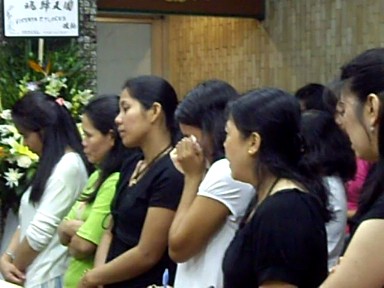
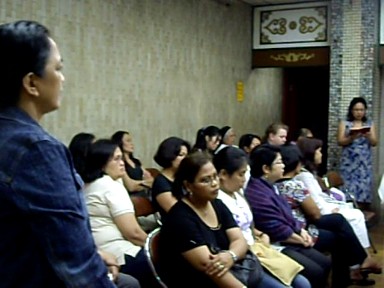

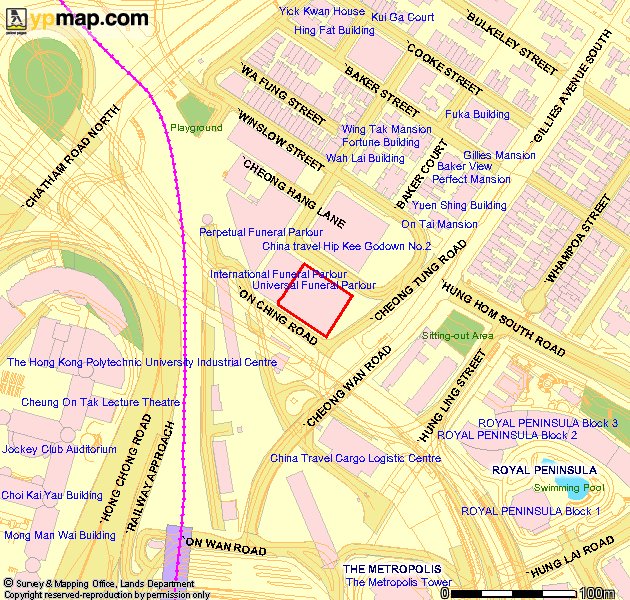



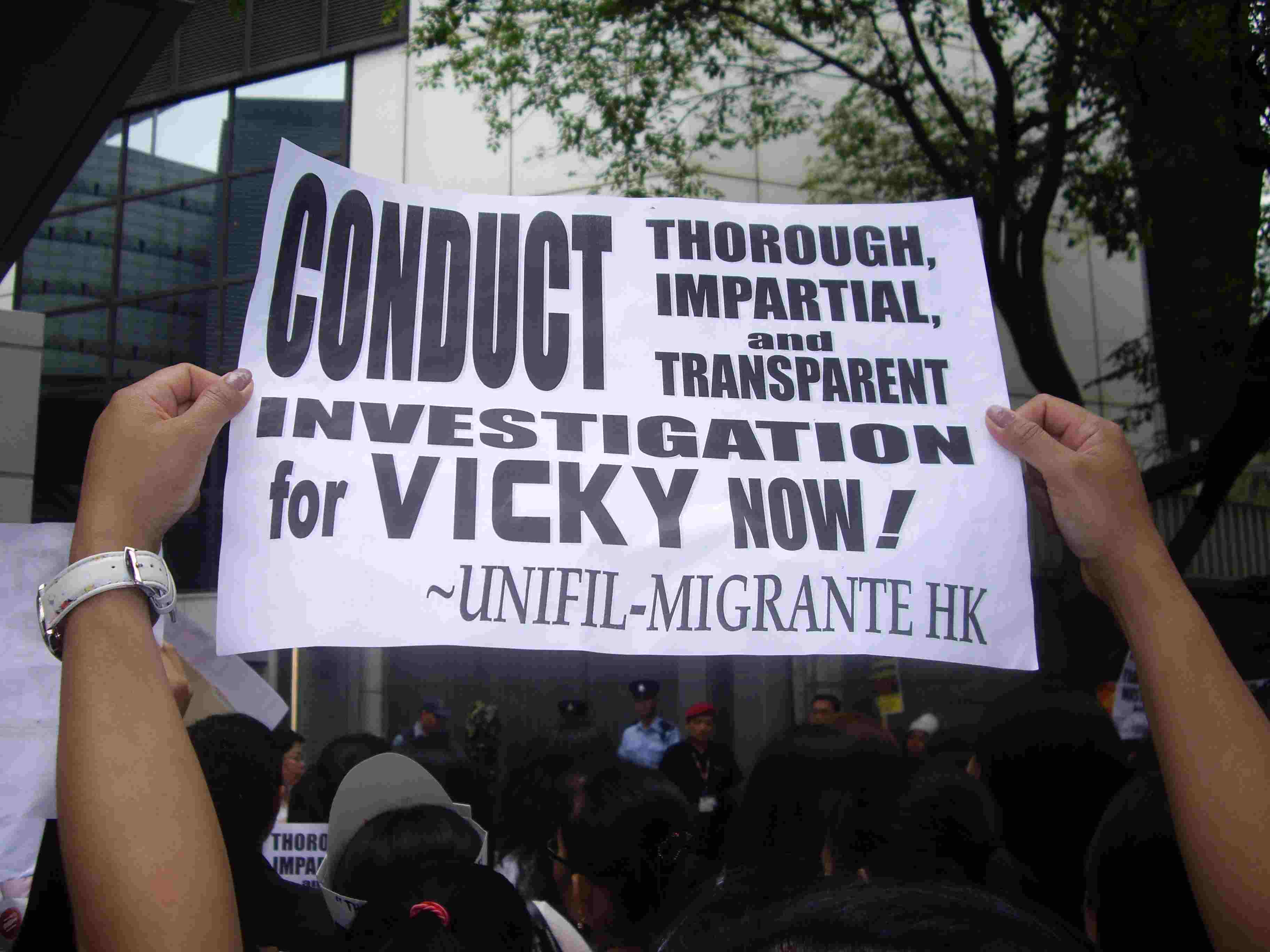





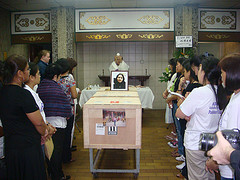


 A Death in Hong Kong
Comments and Intentions
May 29, 2008 by Mike Poole
We thank everyone who has left comments here, especially in the last few days. Our policy is to allow all comments regardless of whether they agree or disagree with anything we have posted. Please feel free to write about the situation, or criticise our coverage if you feel that is warranted.
Blog administrator Mike Poole answers specific questions by email if he has any information to give, but he currently has no information that hasn’t already been posted here.
As a group, including the Discovery Bay residents named in earlier posts, Vicky’s sister Irene, her aunt Edith, Bethune House and the Mission for Filipino Migrant Workers, we feel it important to provide coverage of every significant thing we do in relation to Vicky’s disappearance and death. Hence, the recent inclusion of the letter to the police Chief Inspector on a separate page.
That page, and the letter itself, also reflect our growing belief in the need to discuss wider issues associated not only with migrant worker deaths in Hong Kong, but also with the conditions of employment and general attitudes toward domestic helpers here. As James Rice mentioned at the Rally for Vicky in Admiralty on 27 April, a recently revised electronic version of his handbook on migrant worker rights will be posted here soon.
When we have less to post about Vicky’s case, the blog will be opened to multiple authors for broader coverage or rights-related issues.
Our concern is that people like Vicky be treated fairly under the law, in life as in death. Unfortunately, our recent experience has shown that there is still much inequality in the pursuit of justice in Hong Kong.
We realise that our position will not please all readers, but the Internet is a very democratic arena. Please feel free to register your displeasure or support as a comment. If you fundamentally disagree with us, blogging software is free to use.
The more that these issues are discussed, the better.
Posted in Hong Kong, Police, Rally | Tagged Comments, Migrant Workers, Rights | 1 Comment »